Haber, Robert B. & McNabb, David A.
Visualization Idioms:
A Conceptual Model for Scientific Visualization Systems
This text is partially taken from [HAB90]
Haber & McNabb described a conceptual visualization process in three major
transformations. These transformations occur in most visualization processes, and convert
raw simulation data into a displayable image. The goal of these transformations on the
data, is to convert the information (e.g. gained from a simulation) to a format amenable
to understanding by the human perceptual system while maintaining the integrity of the
information.
- The first transformation is described as data enrichment or data enhancement.
It operates on the raw data which was gained by a simulation for example. The raw data is
modified into derived data for subsequent visualization operations.
-
- The next transformation is the visualization mapping. It constructs an imaginary
object called "abstract visualization object" (AVO) from the derived data
produced by data enrichment and data enhancement. An AVO is an imaginary object with
extensions in space and time. The AVO consists of an attribute field, in which the
(simulation) data is mapped. These attribute fields might include geometry, time, color,
transparency, luminosity, reflectance, and surface texture. To accomplish the mapping
between the (simulation) data and the AVO attribute fields there exists some transfer
functions, which define some simple mappings between them. The transfer functions can vary
widely in complexity.
No fool-proof method exists to derive effective transfer functions. Therefore interactive
systems for real-time modification of the transfer functions are effective tools for
exploring computational data sets.[see reference 1 below] 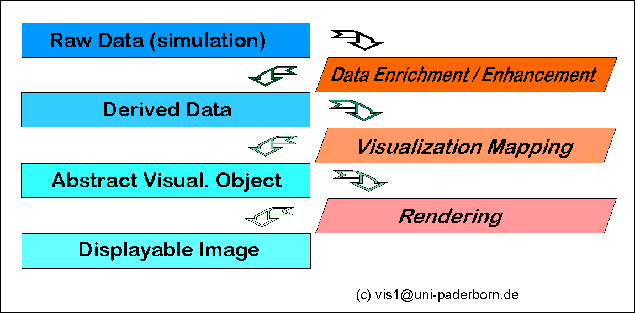
The Figure shows the conceptual diagram of visualization.
-
- The last transformation is the rendering phase. Rendering operates on the AVO to
produce at least one displayable image. The typical rendering operations would include
view transformations (like rotation, translation, scaling, perspective mapping, and
clipping) and optical models (such like hidden surface removal, shading, shadowing,
anti-aliasing, and so forth). Some newer operations deal with volume rendering, which is
an important development for visualizing three-dimensional systems. [see References 2
through 4 below]
-
Other systems that use this idiom: Ignatius' & Senay's VISTA
References:
- D.Cox, "Using the Supercomputer to Visualize Higher-Dimensions: An Artist`s
Contribution to Scientific Visualization." Leonardo, Vol.22, 1988, pp. 233-242.
- R.Drebin, L.Carpenter, and P.Hanrahan, "Volume Rendering", ACM Computer
Graphics, Vol.22, August 1988, pp. 65-74.
- M.Levoy, "Display of Surfaces from Volume Data", IEEE Computer Graphics and
Applications, Vol.8, May 1988, pp. 29-37.
- C.Upson and M.Keeler, "V-BUFFER: Visible Volume Rendering", ACM Computer
Graphics, Vol.22, 1988, pp. 59-64.
 Visualization
Concepts
Visualization
Concepts
Last modified on March 29, 1999, G. Scott Owen, owen@siggraph.org