
 IRIS Explorer
Overview
IRIS Explorer
Overview HyperVis Table
of Contents
HyperVis Table
of ContentsA lattice is an array of values. Bergeron and Grinstein use the notation Lpq for a p-dimensional lattice of q-dimensional data. The dimensionality of the lattice gives its ordering, e.g., unordered data has dimension 0, a vector of data elements has dimension 1, and an array has order 2.
The lattice data type has two arrays, one for the data values (cxData) and one for node coordinates (cxCoord). A node is a point in a lattice defined by a unique coordinate or set of coordinates in Cartesian space. The node values usually indicate the position of the data values. Either one, or both, of the arrays is optional.
There are two dimension variables. NDim is the number of dimensions of the data array (not the number of values in the array). dims is a vector of integer values specifying the number of nodes in each of the nDim dimensions. NDim and dims are defined in the data structures of both cxData and cxCoord, and have the same value in each.
The cxCoord Structure that contains the Cartesian coordinate values that define the position of the lattice nodes, consists of the following:
An example of a 2D lattice structure with seven nodes in each direction and three data variables per node would be the following: nDim = 2, dims[0] = 7 (y direction), dims[1] = 7, (x direction), and nDataVar = 3.
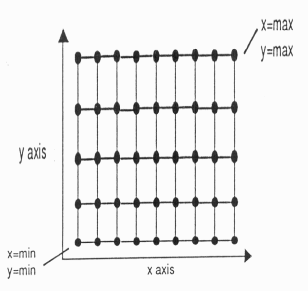
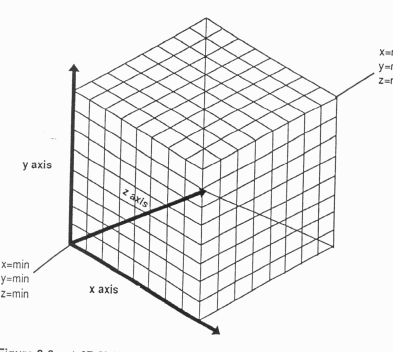
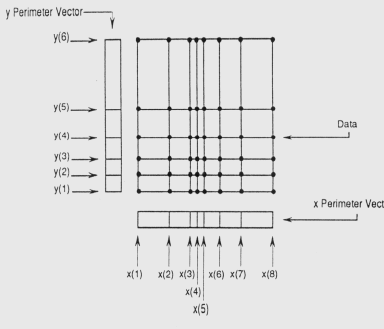
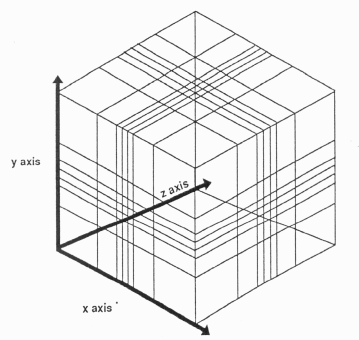
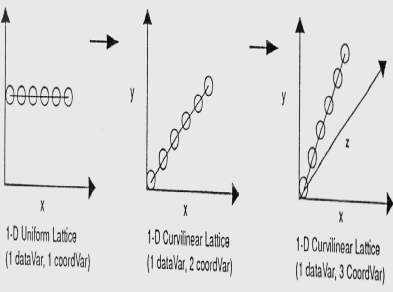
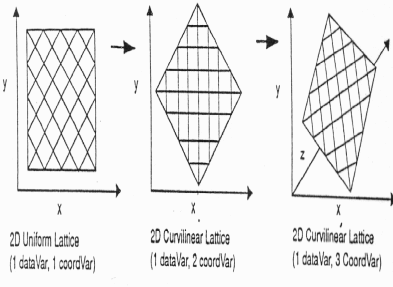
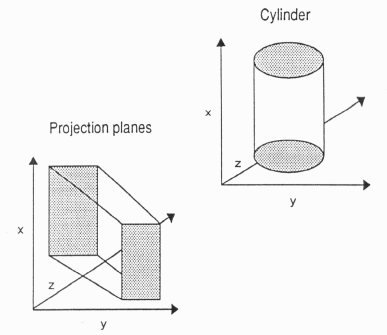
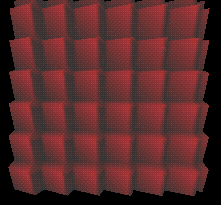
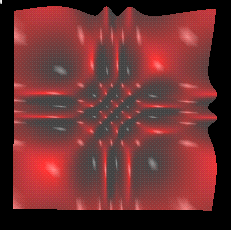
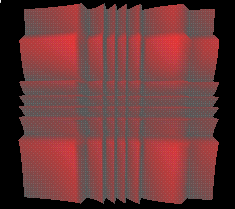
Depictions of different types of lattices:
A colormap is a 1D uniform lattice with four variables per node (RGBA). The elements are: nDim =1 (although it is possible for a colormap to be a function of more than one variable, Explorer currently only has tools for 1D colormaps)
A 2D image is a 2D lattice with either one variable (gray scale), or three variables (RGB), or four variables (RGBA) per node. The elements are: