Visual Illusions
Visual illusions have provided much of the information on which theories of the
functioning of organic visual systems are based
What are visual illusions? In a sense everything we perceive is an illusion since we
can never exactly recreate objective reality through our senses
However the term "illusion" is reserved for those situations in which
our perceptions differ markedly from what we know corresponds to the actual physical
situation. Generally the causative factor is some circumstance associated with the scene
or the context in which it is viewed
We are not surprised when our muscles fail to do exactly what we want and we know that
we can misinterpret the direction of a sound, but we almost never question our visual
decisions in fact we routinely trust our lives to them. How is it possible then, that we
are so readily misled by visual illusions, even when we know what the true situation is?
It is very unlikely that a single mechanism underlies all illusions, in particular the
visual system is able to compensate for the various distortions introduced by the
limitations of the imaging system of the eye
Under normal circumstances, while any compensating function might fail, there appears
to be enough redundancy to detect and correct the error so that the final perception is
faithful to the physical situation
Illusions are produced when we are presented with an impoverished visual environment
that eliminates the normal redundancy and overloads or deliberately misinforms a single
functional system.
| In the Necker cube, two configurations given face in front or given face
in back are reasonable interpretations of the imaged data and there are no cues to cause
one interpretation to dominate. The perceptual system appears to formulate and offer us in
turn these alternative hypotheses. |
Figure Perceptual Ambiguity: multistable perception (from Fischler and
Firschein, 1987) 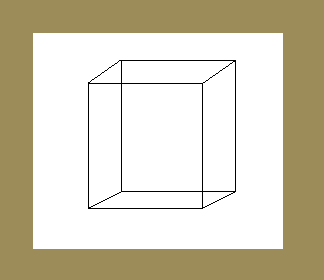
|
| In the "Impossible" triangle we have two separated phenomena:
- when certain visual cues are present, we assume we are viewing a coherent object in 3D
space;
- once we have made this assumption, our visual system assumes that the object we are
viewing is in the general position, i.e., a slight change in our viewing position should
leave our basic perception of the object unchanged
This second assumption seems to be hardwired into our processing, even when we know it
is invalid we cannot avoid invoking it |
Figure The "Impossible" Triangle (from Fischler and Firschein,
1987) 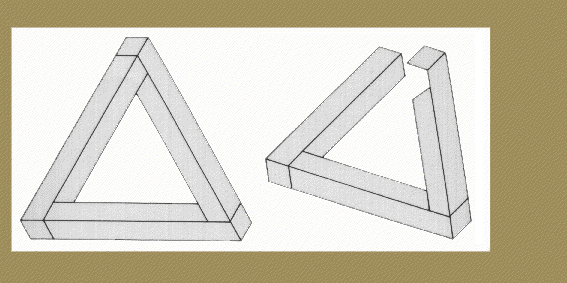
|
| In the case of the subjective contour we use circumstantial evidence (e.g.
gaps in the black circles) to deduce the presence of an occluding object; once this
decision has been made, the interpretation of intensities, distances, etc., are changed to
make the complete interpretation a consistent one. |
Figure Subjective Contours: the white square that appears to be occluding
the black circles is an illusion it is actually the same intensity as the background (from
Fischler and Firschein, 1987) 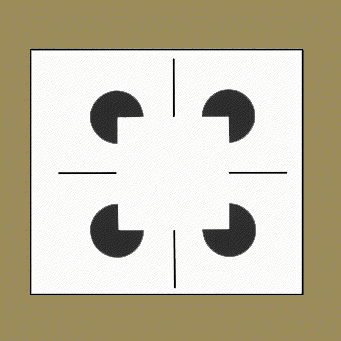
|
All these examples show the existence of a system capable of deductive reasoning and
consistency maintenance operating below the level of our conscious awareness.
References

 Main Vision
Page
Main Vision
Page
 HyperVis Table of
Contents
HyperVis Table of
Contents
Last modified on April 05, 1999, G. Scott Owen, owen@siggraph.org