If C > 0 then N is in the direction of +z, and it faces away from the VRP, therefore, if C > 0 then it is a back face (for a Left handed system).
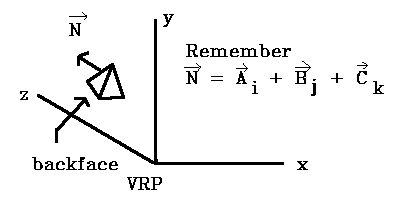
Therefore, if C < 0 then a back face in a right-handed system.
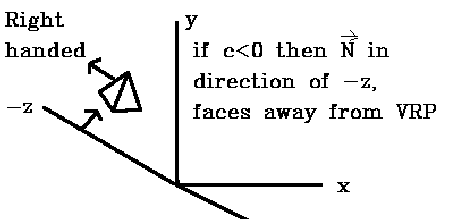
A simple object space algorithm is Back-Face removal (or back face cull) where no faces on the back of the object are displayed. Since in general about half of the faces of objects are are back faces this algorithm will remove about half of the total polygons in the image.
| Look at a left handed viewing system If C > 0 then N is in the direction of +z, and it faces away from the VRP, therefore, if C > 0 then it is a back face (for a Left handed system). |
|
| It is just the opposite condition for a right handed
viewing system. Therefore, if C < 0 then a back face in a right-handed system. |
|
So the algorithm (for Left-handed system):
Note that we must be able to identify the polygons for the object.
| This simple method is only correct for an orthographic projection. For a perspective projection, it is a little more complicated. For the scene below, the visible surfaces are different for orthographic or perspective projection. The sides will be invisible for an orthographic projection, but not for a perspective projection. | 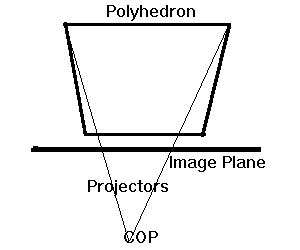 |
For a perspective projection, we must determine if the Center of Projection (COP) is inside or outside of the planes of the polygons of the object. If the COP is inside then that plane is not visible, if the COP is outside then it is visible.
There are two methods to compute this:
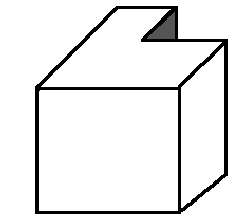
Even if we use another algorithm for visible surface determination, the back-face cull is a good pre-processing step., once it removes about half of the polygons in the scene. Also, for color shading we must compute the normal for all of the polygons anyway.

 Visible Surface Determination
 HyperGraph home page.