 Splatting
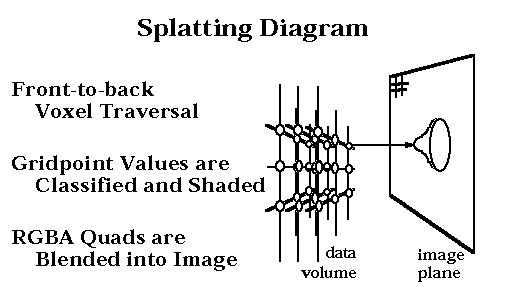
Splatting performs a front-to-back object-ordered traversal of the voxels in the dataset. Each voxel's contribution to the image is computed and added to the other contributions.
The first step is to determine in what order to traverse the volume. The closest face (and corner) to the image plane is determined. Then the closest voxels are splatted first. Each voxel is given a color and opacity according to the look up tables set by the user. These values are modified according to the gradient.
Next the voxel is projected into image space. To compute the contribution for a particular voxel, a reconstruction kernel is used. For an orthographic projection a common kernel is a round Gaussian. The projection of this kernel into image space (called its footprint) is computed. This size is adjusted according to the relative sizes of the volume and the image plane so that the volume can fill the image. Then the center of the kernel is placed at the center of the voxel's projection in the image plane (note that this does not necessarily correspond to a pixel center). Then the resultant shade and opacity of a pixel is determined by the sum of all the voxel contributions for that pixel, weighted by the kernel.
A voxel's contribution is high near the center of its projection and lower when far from the center. This is sort of like the splat a snowball makes when thrown against a wall. Depending upon the relative sizes of the volume and image plane, several voxels may contribute to a single pixel or a single voxel may contribute to several pixels.
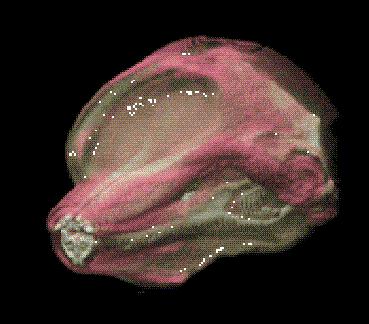
Dolphin Head (Cranford, Elvins, Mercurio)

 Back to DVR Algorithms
 HyperVis Table of
Contents
HyperVis Table of
Contents
Last modified on February 16, 1999, G. Scott Owen, owen@siggraph.org