Rosalee Wolfe
DePaul University
wolfe@cs.depaul.edu
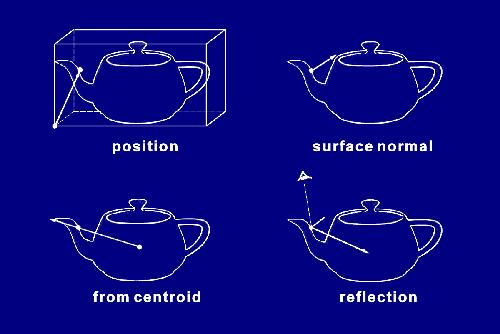
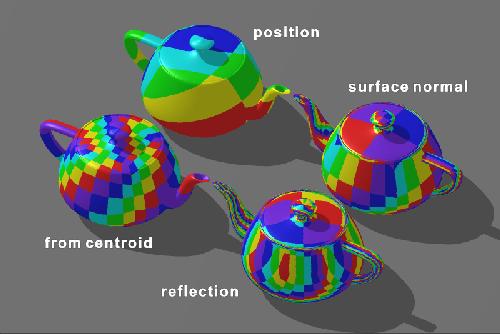
| 22: Remember that we choose a map shape and a map entity when texture mapping. When discussing map shape, we talked about taking an (x,y,z) value from the object and converting in various ways, but we didn’t mention what that value was. The map entity determines what we use as the (x,y,z) value. Commonly-used map entities are 1) a point on the object relative to the object’s bounding box, 2) the surface normal at the point being rendered, 3) a vector running from the object’s centroid through the point, and 4) the reflection vector at the current point. Remember that the reflection vector depends not only on the position of the point and its normal, but on the position of the viewer. | |
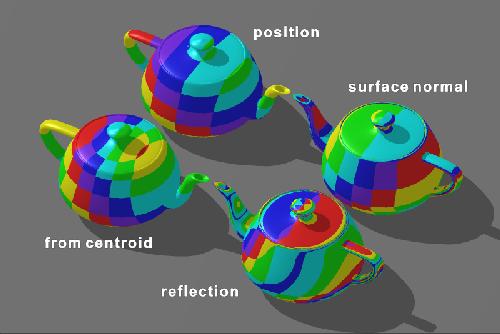
| 23: This next sequence of slides shows the interaction of map shape and map parameter. The map shape is the same for all the teapots on this slide. What is it? | |
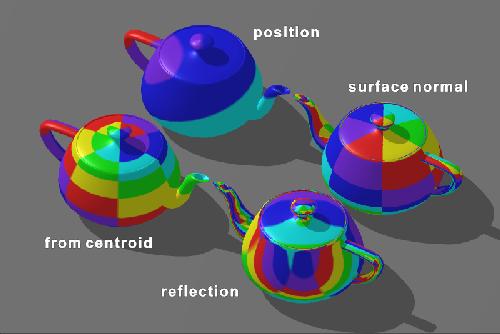
| 24: Some combinations of map shape and map parameter produce more useful results than others. For a cylindrical map shape, which map parameters seem to produce the best results? | |
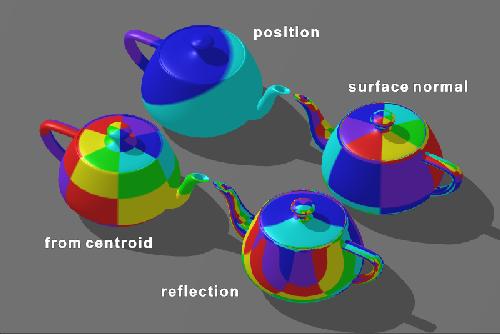
| 25: Which map parameters look good with a spherical map shape? Compare map parameters best for cylindrical map shape with those best for a spherical map shape. Are there any similarities? | |
| 26: Can you guess the map shape? | |
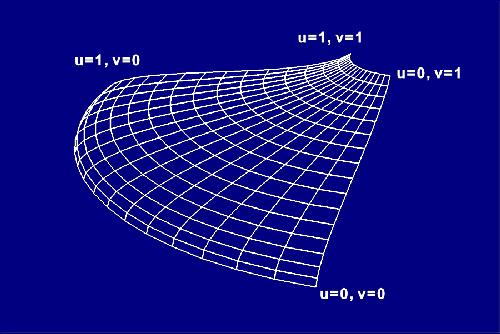
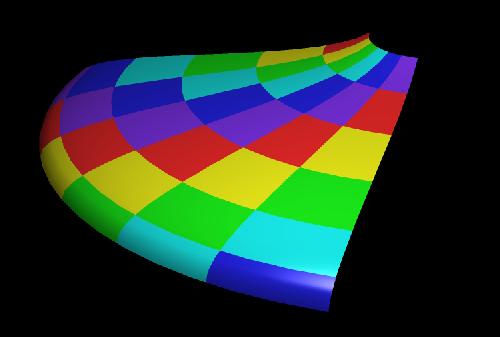
| 27: When rendering a parametric patch, we can dispense with map shape and map entity by treating the u- and v- parameters of the surface as if they were normalized device coordinates (Catmull, 1974). Multiplying u and v by the resolution (in pixels) yields the device coordinates of the desired pixel in the texture map. | |
| 28: Here is the same patch with its texture map. | |
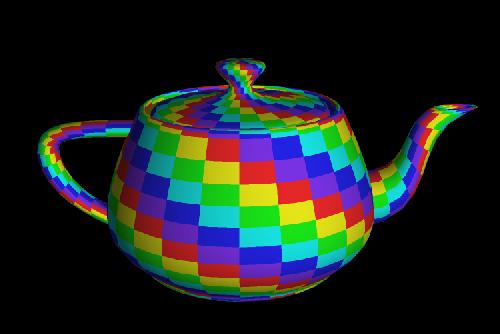
| 29: The model for this teapot has 32 parametric patches, each of which sports a copy of the texture. This slide shows the use of the u,v parameters to select the coordinates of desired color in the texture image. | |

 Main Mapping Page
 HyperGraph Home page.
Last changed May 29, 1999, G. Scott Owen, owen@siggraph.org
 Next Pag