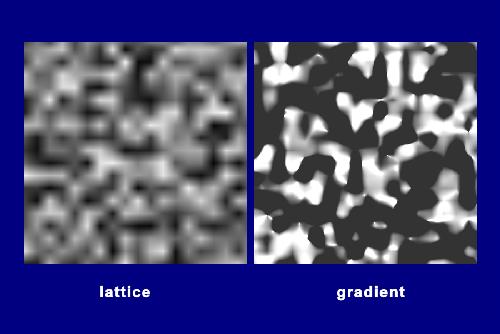
| 45: In lattice noise, maxima and minima always occur at
regularly-spaced intervals, since it first fixes values to the (integer) positions of the
lattice and interpolates to obtain intermediate values. The regularity of these maxima and
minima can be noticeable to an observer, as demonstrated in this slide. Gradient noise
does not suffer from this problem. |
 |
| 46: We can change the frequency and amplitude to vary
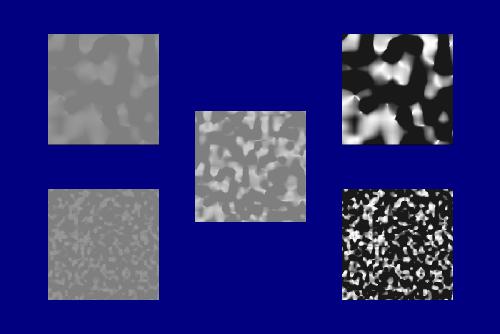
the nature of the noise. The middle image in this slide depicts the function noise(x,y,z)
We can vary the effect of the noise by using the expression
noise(f*x, f*y, f*z) * a
where f controls the frequency and a controls the amplitude. Noise having
large amplitudes will result in a greater range of colors. Noise having high frequency
will contain more detail. In the slide there are four images surrounding the depiction of
the original noise function. Which image portrays noise having lower frequency and lower
amplitude than the original? Which has higher frequency and lower amplitude? |
 |
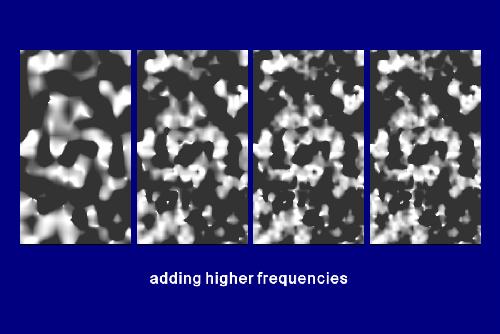
| 47: This is a demonstration of how 1/f noise is
created. We begin with a noise function, depicted on the left. To this we add the same
noise function with twice the frequency and half the amplitude, which results in the
second picture. The third image is the sum of the noise in the second picture plus the
noise function with four times the frequency and a quarter of the amplitude. We can
continue adding noise of higher and higher frequency until the frequency is so high that
something as large as a pixel won’t be able to record it. |
 |
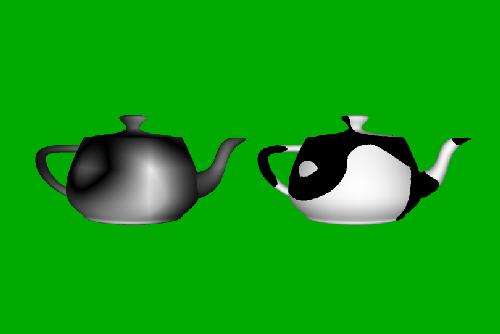
48: Here we finally begin seeing some application of
noise to texture mapping. To get a Wisconsin-styled black-and-white spotted teapot, use
the following pseudocode:
gray = noise(x,y,z)
if(gray > threshold)
choose white else
choose black
|
 |
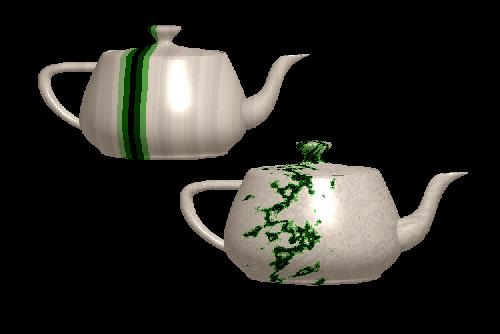
| 49: Perturbing stripes can result in a texture with a
marbled appearance. |
 |
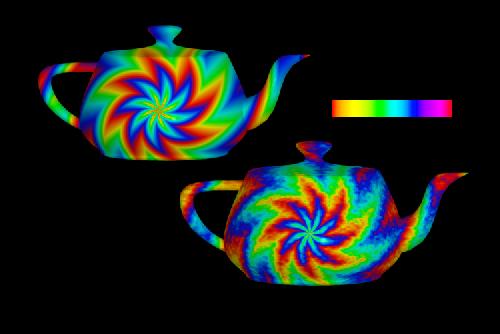
| 50: This is the "Grateful Teapot", created by
perturbing a "pinwheel texture" to produce an index into a color table. This
texture was created by Kevin Ferguson. |
 |
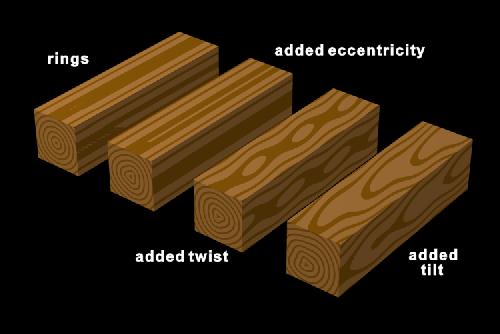
| 51: Making a wood-grained object begins with a
three-dimensional texture of concentric rings (Peachey, 1985). By using noise to vary the
ring shape and the inter-ring distance, we can create reasonably realistic wood. |
 |
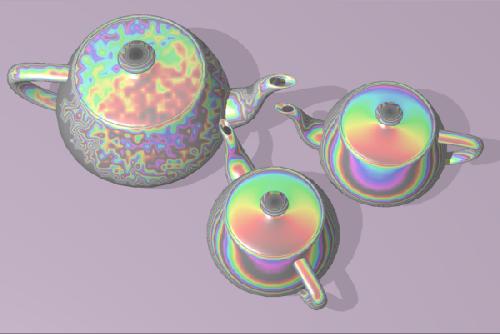
| 52: We can create an irridescence effect by combining
the color from a color table with the object’s original color. Adding noise to
perturb the color table lookup creates a mother-of-pearl effect. |
 |
 Next Page
 Previous Page
 HyperGraph Home page.