Rosalee Wolfe
DePaul University
wolfe@cs.depaul.edu
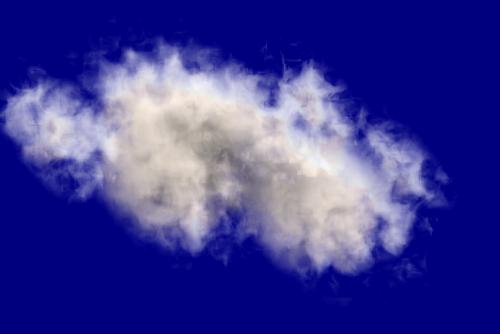
| 53: Procedural functions can not only determine an object’s color, but its geometry as well. Volume density functions describe the geometry of gases and are similar to solid texturing procedures in that they take a point in three-dimensional space as input and return a value. Instead of returning a color, they return a density value. The cloud in this image is a procedurally altered metaball created by David Ebert. | |
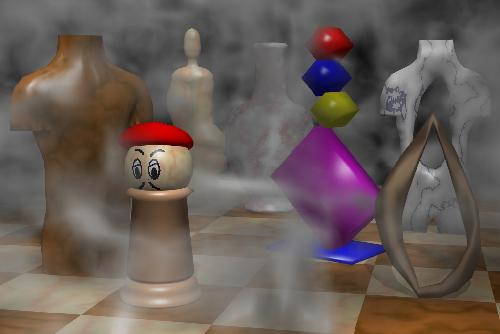
| 54: This still is from the movie "Getting Into Art", by David Ebert and diplays another example another example of a volume density function. Name the texture mapping techniques you see. Which are the 3D textures? | |
| 55: All the frames in the movie "Toy Story" were rendered using Pixar’s Photorealistic Renderman. In Renderman, textures are added via the use of "shaders". Compare the horse pattern on the quilt to the wood pattern in the headboard. Which is more likely to be a 3D texture? | No image available |
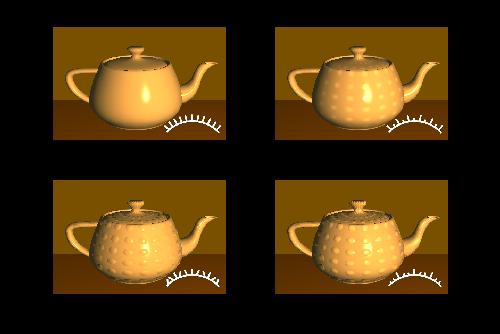
| 56: Bump mapping affects object surfaces, making them appear rough, wrinkled, or dented (Blinn, 1978). Bump mapping alters the surface normals before the shading calculation takes place. It’s possible to change a surface normals magnitude or direction. | |
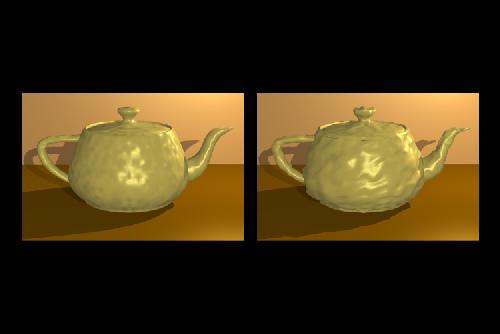
| 57: In the upper left image, lattice noise alters the magnitude of the teapot’s surface normals, which creates a rough-looking surface. Lattice noise at a lower frequency changes the magnitude of the surface normals of the upper right teapot. It appears dented. The lower left teapot is the result of using sin(y)/ 2 + .5 to scale the normals magnitude, which results in a rippled effect. In all cases the profile of the teapot is still smooth. Bump mapping does not change the underlying geometry of the model, but fools the shading algorithm to produce an interesting surface. | |
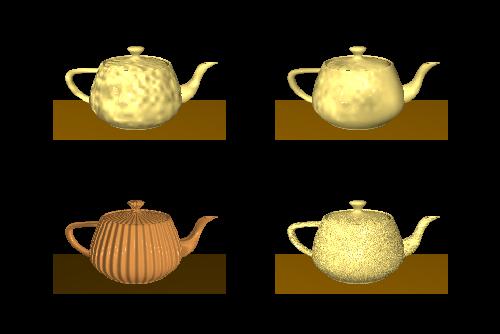
| 58: In contast, displacement mapping alters an object’s geometry (Cook, 1984). Compare the profiles and the shadows cast by these two objects. Which is bump mapped? | |
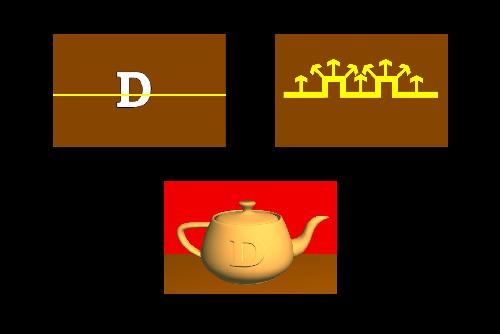
| 59: Embossing is a form of bump mapping. To emboss the letter "D" onto the teapot, we map each point of the object into the "D" image. If we land at a location where there is a transition from white to black, then we rotate the point’s surface normal by an angle theta. If we land at a location in the "D" where there is a transition from black to white, then we rotate the point’s surface normal by -theta. If we land at a location where there is no transition, we don’t do anything to the surface normal. | |
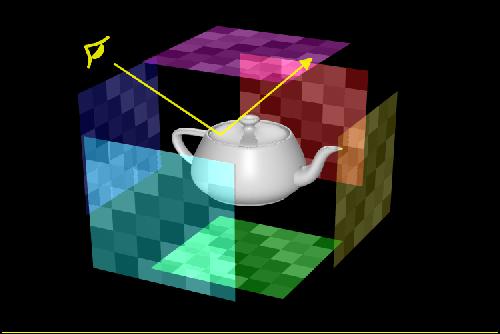
| 60: Environment mapping is a cheap way to create reflections (Blinn and Newell, 1976). While it’s easy to create reflections with a ray tracer, ray tracing is still too expensive for long animations. Adding an environment mapping feature to a z-buffer based renderer will create reflections that are acceptable in a lot of situations. Environment mapping is a two-dimensional texture mapping technique that uses a map shape of a box and a map parameter of a reflection ray. | |

 Main Mapping Page
 HyperGraph Home page.
Last changed May 30, 1999, G. Scott Owen, owen@siggraph.org
 Next Page