Rosalee Wolfe
DePaul University
wolfe@cs.depaul.edu
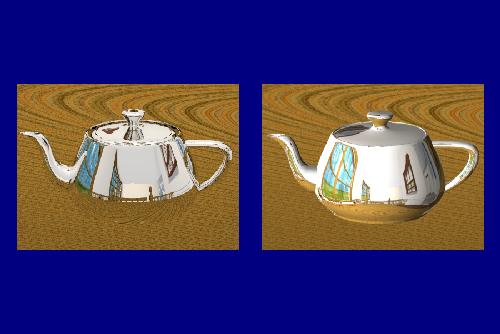
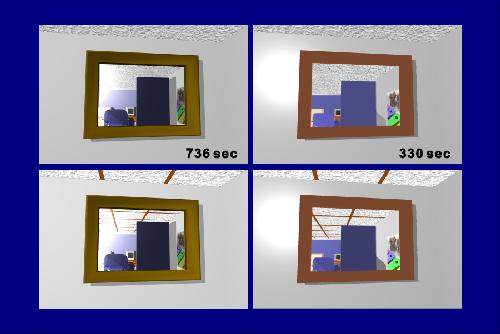
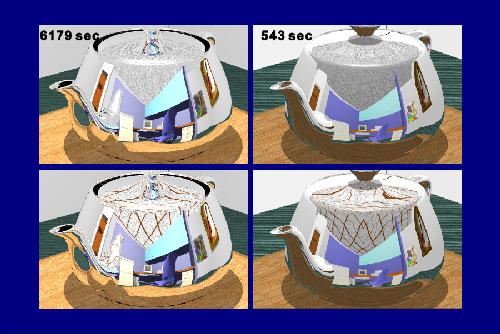
| 61: Here are side-by-side comparisons of raytracing and environment mapping. What differences can you see? | |
| 62: Environment mapping is cheaper than raytracing and works well when the reflective surface is planar or convex and there are no obvious sets of parallel lines in the reflection. In the top example the results from environment mapping compare favorably with raytracing, but in the lower example, the reflected lines of the ceiling tiles do not align with the actual ceiling. | |
| 63: Notice the difference in rendering times between raytracing and environment mapping. Compare the difference in appearance. | |
| 64: In this still from "Toy Story," what techniques are being applied to Slinky Dog’s ear and Rex’s skin? This image is not raytraced, yet reflections of Slinky Dog and Rex are visible in the highly polished floor. What technique created this effect? | No image available |
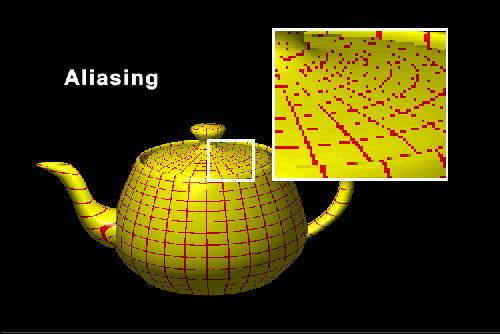
| 65: No matter the type of mapping we’re undertaking, we run the danger of aliasing. Aliasing can ruin the appearance of a texture-mapped object. | |
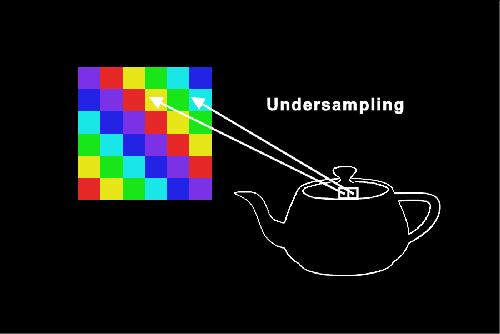
| 66: Aliasing is caused by undersampling. Two adjacent pixels in an object may not map to adjacent pixels in the texture map. As a result, some of the information from the texture map is lost when it is applied to the object. | |
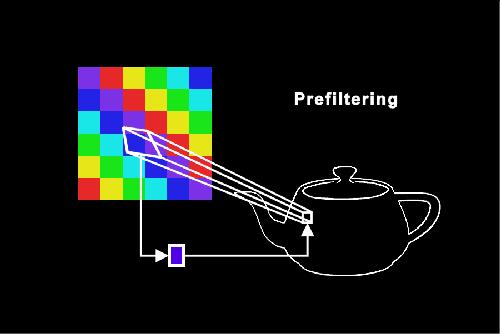
| 67: Antialiasing minimizes the effects of aliasing. One method, called prefiltering, treats a pixel on the object as an area (Catmull, 1978). It maps the pixel’s area into the texture map. The average color is computed from the pixels inside the area swept out in the texture map. | |
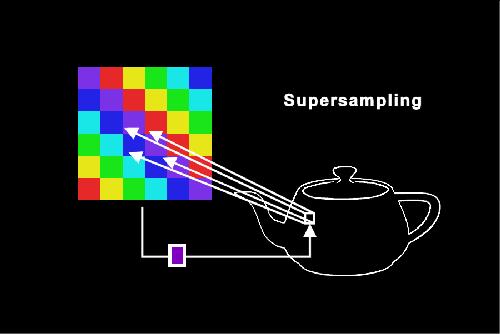
| 68: A second method, called supersampling, also computes an average color (Crow, 1981). In this example each of four corners of an object pixel are mapped into the texture. The four pixels from the texture map are averaged to produce the final color for the object. | |

 Main Mapping Page
 HyperGraph Home page.
Last changed May 30, 1999, G. Scott Owen, owen@siggraph.org
 Next Page